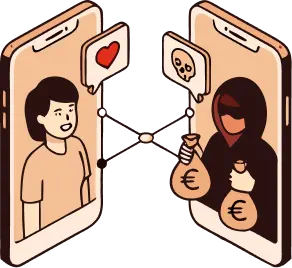



The case of a victim we will call Maria illustrates the danger of ‘clone firms’, where scammers impersonate legitimate, licensed financial services providers to steal funds. Maria unknowingly began corresponding with a fraudster posing as a representative of a well-known licensed firm. The interaction started through mobile text messages, where the impersonator guided her to execute specific forex trading positions. Maria started with a modest initial investment of just €250 in 2023. When her early trades appeared to close at a profit, she was lured into believing she was dealing with a highly skilled professional.
As the relationship progressed, the fraudster used ‘fear of missing out’ tactics, regularly notifying Maria of various lucrative opportunities she was supposedly losing. When Maria expressed that she lacked the time to manage the trades herself, the impersonator offered to take over her account. Shortly thereafter, he claimed to have enrolled her in ‘special projects’ involving crypto-assets that had yielded massive, fictitious returns. To facilitate the withdrawal of these purported profits, Maria was encouraged to open an account with a well-known crypto exchange for ‘tax-related reasons’.
To further solidify her trust, the scammers performed a ‘test withdrawal’, allowing Maria to successfully move a small amount of money back to her bank. This was followed by a series of coordinated emails from a fake account impersonating the well-known crypto exchange. The fraudsters then began a calculated cycle of demanding substantial payments before her profits could be released. They used a variety of professional-sounding excuses, including the need for ‘liquidity checks’, ‘insurance purposes’, and ‘unfreezing funds’. To create what they called a ‘history of transactions’, they requested three specific transfers of $2,500, $10,000, and $30,000.
In a classic psychological trap, the scammers returned the first and second transfers to Maria to alleviate her concerns. However, once she sent the third and largest payment of $30,000, the money was never returned. Maria continued to make payments for ‘cashflow purposes’ through ‘Trust Wallet’ and additional ‘liquidity checks’ after being told her previous conversions were incorrect. The deception only ended when the scammers attempted to extract a final ‘international tax payment’, at which point Maria realised she had been defrauded of over €70,000.
Warning signs and red flags:
- The promise of easy and guaranteed profits is a primary indicator of a fraudulent scheme.
- All professional communication is conducted exclusively through electronic messaging with no opportunity for in-person meetings.
- The representative uses constant pressure and the fear of missing out to encourage larger investments.
- The platform notifies the user of substantial and unrealistic profits over an incredibly short period of time.
- Multiple requests for substantial upfront payments are made as a condition for the release of funds.
- There is an extreme sense of urgency suggesting that funds will be lost or blocked if payments are not made immediately.
Disclaimer: This account is based on a real-life case investigated by the authorities. While the events and figures described are factual, names have been changed to protect the privacy of the individuals involved.